Showing posts with label Cinéma et Télévision. Show all posts

05 April 2022

Matins sans frontières

Pendant le mois de mars 2022, j'ai eu le plaisir d'être invité à quelques reprises pour parler d'histoire à l'émission Matins sans frontières sur les ondes de Radio-Canada. Voici les liens pour écouter les clips qui font environ 8 à 9 minutes chacun. Bonne écoute!

• 2022 Entrevue à Radio-Canada. Matins sans frontières. « Les femmes dans l’armée pendant la Conquête ». Windsor. Diffusé le mercredi 30 mars 2022. En ligne : https://ici.radio-canada.ca/ohdio/premiere/emissions/matins-sans-frontieres/episodes/617153/rattrapage-du-mercredi-30-mars-2022/16 

• 2022 Entrevue à Radio-Canada. Matins sans frontières. « Page d’histoire : La fin du régime français à Détroit ». Windsor. Diffusé le jeudi 23 mars 2022. En ligne : https://ici.radio-canada.ca/ohdio/premiere/emissions/matins-sans-frontieres/episodes/615621/rattrapage-du-mercredi-23-mars-2022/7

• 2022 Entrevue à Radio-Canada. Matins sans frontières. « La Nouvelle-France au cinéma ». Windsor. Diffusé le jeudi 17 mars 2022. En ligne : https://ici.radio-canada.ca/ohdio/premiere/emissions/matins-sans-frontieres/episodes/614295/rattrapage-du-jeudi-17-mars-2022


07 September 2020

Barkskins: Dud on Arrival

My reaction after watching.

This review has been a long time coming, and I must apologize to my readers who have been pushing me on this matter and I thank them for their patience. My summer has been a paradox of trying to relax after the arduous completion of my doctoral dissertation, all the while jumping right back into full time work (and then some) in the middle of a pandemic.

And so here we are. New France is the setting of National Geographic’s brand new series Barkskins. Released earlier this year, the story follows a handful of characters trying to get by and scrape a living in and around the fictional town of Wobik somewhere near late-17th-century Québec (or Québec City, as they keep calling it anachronistically). The central plot revolves around political intrigue between French and British characters using murder and deceit—all the while roping in the Haudenosaunee (Iroquois)— to push their own gains.

The series is based off part of the novel by Annie Proulx, an American author whose most recognizable work is Brokeback Mountain. I’ll be honest: I’ve only read the first third of the book, being the only part taking place under the French Regime. From cringy writing to anachronisms aplenty, it was not a pleasant read. Once my curiosity was satisfied over seeing how New France was represented, I was happy to move on to something else. I had many issues both with the background and details of the setting, too numerous to detail here (and I especially don’t feel like spending more time double checking the many other details which raised serious doubts in me). To name only a few annoyances, the author mixes up Champlain with Cartier, constantly talks about Ville-Marie even though Montréal was the official name of the settlement by then, misspells the names of historical character that actually existed, and finally, keeps implementing the jarring and forceful use of French words (often misspelled at that: how many times can someone misspell Tabarnac differently with each use, really?). Her overarching theme also suffers from a lack of understanding of New France’s social and economic structure. Though the novel’s central theme is about deforestation and implied settler colonialism, the novel disregards the strict control of French immigration which, to Indigenous eyes, made the French far less of a threat than their British neighbours: at it’s height, New France never had more than the equivalent of 5% of the Thirteen British Colonies’ population, explaining much of why the French had such strong alliances with various First Nations. Such policy and cultural differences are also the reason why Settler Colonialism is not necessarily the best model to apply in understanding New France[1], but I digress. Also contradicting the novel is the reality that by the end of the French Regime, the French had not yet decimated the forests nearly as badly as Proulx makes them out to be. Not only that, but New France was a colony that was closely managed by the French crown under the principles of Colbertism; the mercantiliste nature of the colony stifled individual free enterprise. Indeed, her entrepreneur character would never have been allowed to jump willy-nilly between borders between competing colonial empires. Jumping around Canada, Maine and China (!), this character tries to create an international lumber market for his mills, even though lumber was tightly protected by the French crown and could only be used under strict conditions. All in all, Proulx's novel rests on an anachronistic and culturally swapped New France where French colonial society as depicted is closer to 19th century capitalistic American society in the middle of Manifest destiny. In the end, the novel ends up giving the uninitiated reader a bizarro version of New France, one that never existed.

In turn, to be blunt, the majority of my issues with the series stems directly from Proulx’s story. To boot, additional plot points just keep adding to the mess. The entire plot of the series crumbles when one spends two seconds to wonder why in the world is the Hudson’s Bay Company operating out of Québec? This is as glaring a mistake as portraying the Kremlin openly operating a naval base on U.S. soil during the Cold War…

As a historian, I often evaluate historical fiction’s merit not so much on whether it is accurate, but rather whether it is at least authentic—the nuance being that before being accurate, it is important to convey to the audience the gist of the period. Considering the medium, one is often forced to bend the “accuracy” to best fit the time constraint of a movie or series, yet hopefully still leaving the audience with a better idea of the period. Hence the importance of “authenticity” over “accuracy”. Yet Barkskins fails at both.

In a nutshell, Barkskins is a myopic Americanized distillation of New France into a crude, uninteresting caricature. This particular historical setting brings nothing to the story that could not have been done elsewhere (one thinks of the mediocre Frontier by Discovery Channel, another waste of a good name as we shall see…). Even beyond the historical inaccuracies, the actual story line is a bore and only manages to pick up in episode 6… out of 8. Also, if you're going to write a historical fiction, you have to make sure your characters are more interesting than the contemporary people that actually existed in the same timeframe. From the first episode, all the characters are insufferable. If this wasn't a series on New France, I would have watched something else long ago. Also, the pursuit of drama for drama's sake is as ridiculous as portraying this colonial period through rose-coloured glasses: the resulting caricature cheapens and distorts the audience's perception of how this past really was. Frankly, I only recommend watching the entire thing if you’re a glutton for punishment.

To knock off just a few of my issues with the series, here is a short list (except for a few glaring mistakes, I will put asides the props and costumes because I am not a material culture specialist. I would love to hear my colleagues’ opinions on this matter, though.):

  • The female characters smack of so many clichés, the series disregard the actual history of women in New France and denies their actual agency which was relatively important for the period.
  • Frenglish (“Le Grand Inn”)
  • Music: in a scene, a fiddler is seen playing the Maple Sugar reel. Slight problem: though most people associate this tune with French-Canadians, it was composed in the 1950s by Ward Allan of Ontario!
  • The actors speak in “outrageous French accents” straight out of Monty Python, yet often so undecipherable that I had to watch with the subtitles on. And when they were not speaking with so thick an accent, I had trouble understanding at first who was French and who was British.
  • The writing is awful, with lines like: "I keep my distance from Empire […] I serve the King" or "Let us finish our tea like good British subjects".
  • Women walking around with their heads uncovered as usual, contrary to period fashion and etiquette.
  • Beards. So many anachronistic beards. This series is so beardy, ZZ Top is guarding the gate and facial hair makes its way into the terrible dialogue with lines like “"My beard can sense another man's intentions, it has barbules that poke out into the minds of others.” (No, I’m not making this up).
  • Nitpick: terrible cgi birds.
  • The script really goes out of its way to portray every single character as terrible. Even children get stabby. Can we get over the “gritty realism” trend already where characters are nothing more than bland avatars of angst simply for drama’s sake? (aka everybody is insufferable and pissy... and the Wendat are literally pissy in episode 2!)
  • Though some of the actors had genuine chemistry, the writing did not allow them to properly play off of each other because God forbid they might have fun together for a second.
  • In the middle of the expansion of the French Atlantic Empire, Trépagny has nothing better to offer the Filles du Roi to demonstrate his social standing than a bag of sugar cubes and a couple of cinnamon sticks. Come on man, you can do better.
  • The presence of the Troupes de la Marine is either too early, or the Filles du Roi are too late.
  • I made the mistake of getting excited when Oscar co-winner Rémy Girard appeared on screen as the first and only actual French-Canadian actor who so far as I could tell was not an extra. My excitement was over when it turned out he plays “Intendant de Fer”. De Fer? Apparently no one could be bothered spending 15 seconds on Wikipedia for such basic information as the name of the Intendant that year instead of making one up.
  • Manifest Destiny vibes keep being injected into the story with lines like "mothering this new land," etc. 
  • The Indigenous people are merely props. We barely know any by name, no effort is put into explaining each nation's respective grievances, wants, and situations beyond quick, vague, and inaccurate lines. In fact, they have less agency than in Proulx’s novel. Mari’s character, for example, is merely defined by the men she's with and her need of Trépagny (Come on girl, move out. You're better than this.). Meanwhile the Haudenosaunee are constantly being labelled as merely useful tools of the British, disregarding the actual influence and agency of the Five-Nations. Speaking of misrepresented relations, in episode 7, Captain Bouchard strangely talks about sending the army against the Wendat.... Who not only are very close French allies, but refugees at Québec... Otherwise, by the time there’s a bit of added character building with the Indigenous characters in the last two episodes, it all feels too little too late in what should be a much richer, more complex political world of Indigenous-Colonialist relations all the while giving individuals proper voices.
  • Stupid tropes about people being dirty in the past (ex: "Leave the dirt: it's what's going to make you heal".)
  • Nuns in the woods to confront the Haudenosaunee. Whatever.
Things I loved:
  • David Thewlis. Good God, David Thewlis: sure, his character would never have been a seigneur in real life because of his way-too-openness-to-talk-about-his-Protestantism-in-the-middle-of-a-staunchly-regulated-catholic-society (and not only a Protestant, but a Cathar to boot, 200 years after Cathars stopped being a thing…), but he is fascinating to watch. Thewlis plays his Trépagny like a character having gone mad from working on the set of The Island of Dr. Moreau (inside joke for your cinephiles. I swear Thewlis really is channeling is best exasperating Marlon Brando).
  • Some welcome faces like actor Rykko Bellemare of Hochelaga: Terre des âmes (though I wonder if they dubbed over his lines to make him sound more “menacing” or if somehow the sound alignment was off on his lines for some reason…)
  • I loved the recreation of Place Royale's water front on the actual location (even though the water line should have been much closer to the buildings). However, most locals will snicker at the odd direction the characters are going following the streets, teleporting from one end of a street and onto the other. Forgive me for enjoying myself being petty and pointing this out.
  • The Huron-Wendat long houses are gorgeous.
  • The cinematography is amazing. The Forest feels a whole lot more like a character in the series than in Proulx's writing.
  • I will begrudgingly admit that the two final scenes in the last 4 minutes of the episode, though ending on a cliff-hanger (good God, enough...), are amazingly gorgeous.

All this said, my biggest issue with the series begins with the very first image following the title card in the very first episode: on the fictional Wobik’s waterfront, the camera pans to a large, dead tree covered with the corpses of Haudenosaunee warriors, both hanging and impaled. Explained away as being a “warning”, this gruesome display flies in the face of the historical record and of the political, cultural, and military context of the period. And just to be sure, I even felt obliged to consult a colleague specializing in 17th century Franco-Indigenous relations to confirm my own knowledge on the matter: indeed, no such overt desecration of bodies in front of a settlement ever took place by French authorities. True, executed French criminals could be exhibited on a noose, and the French were indeed at war with the Five-Nations throughout much of the 17th century. But such a display of barbarity on the scale illustrated in this episode is total nonsense. First of all, such a provocative act would have been incredibly counterproductive to the ongoing diplomatic negotiations for peace by scandalizing the Five-Nations and also insulting Haudenosaunee allies. Secondly, in a highly codified society, the French by the late 17th century were sticklers for the proper conduct of war, tired of the last few centuries of mercenary warfare and open violence which often lead to escalation. Indeed, by this place in time, the driving ideals of late 17th century French and European martial theory centered instead on controlling and limiting any and all types of violence to a regulated army that would “efficiently” wage war with as little casualties and collateral victims as possible. Desecrating enemy bodies was consequently obviously frowned upon. This said, violence against Indigenous people by individual colonists unsupervised by authorities was certainly a reality. As well, terrorism as a tactic in “la Petite guerre” was certainly in use, though most often reproducing Indigenous warfare tactics. Finally, state sanctioned violence in the 18th century would indeed escalate against the Fox and Natchez. However, such an extreme and overt display of desecration as seen in Barkskins at this time and context would have never been condoned nor instructed by French officials, especially in a time where the French understood full well that the Five-Nations could eliminate them if they chose to. And yet, this gruesome fictional example is clearly shown as being sanctioned by the local officials of the town, giving the impression to the audience that the French acted in such a manner.

In the current political and cultural reckoning sweeping the Western World over colonialism, French-Canadian society is also grappling with its colonial past, with the added complication of having being both the colonizer under the French Regime and the colonized under the British Regime. Accurately weighing and comparing the legacy of Franco-Indigenous relations—including determining exactly what violence was actually committed and in what context—is therefore important to understand those same relations today, especially as violence against Indigenous communities is still being committed as we speak and that denialism of this fact is rampant. However, fictional violence and misrepresentations of these early interactions with Indigenous peoples (manufactured by National Geographic no less) only ends up muddying the waters as we are having a hard enough time as it is parsing through how French Colonialism was different from British and Spanish colonialism, and how learning from this can help society deal with colonial wounds.

On one hand, a large part of the series’ promotional pitch was that producers had consulted Indigenous scholars, but on the other, this doesn’t mean squat. The producers had also consulted a bare minimum of New France specialists and yet, I can confirm after digging around, they barely took their suggestions into account. Saying you consulted with specialists is not the same as demonstrating that you actually listened to them. Once again: true, though Barkskins is problematic in and of itself merely on the basis of historical accuracy alone, the series could have been waved away as mere entertainment produced in a gauche manner. However, its attachment to what the general public still assumes is the good name of National Geographic is alarming in a post-truth world. If the medium is the message, people latch onto the name of National Geographic and immediately think what they are watching is accurate and truthful. The average audience member may not remember that in 2015, 21st Century Fox obtained a 73% share of the National Geographic Society’s assets and in turn, shifted its philosophy[2]. Suffice to say, since this shift, the society’s good name is being used to sell doubtful narratives[3]. One only needs to think of National Geographic’s 2015 two-part miniseries Saints & Strangers, a dramatic telling of the first arrival of the Pilgrims. However, once again, the producers had stressed that they had approached Indigenous consultants, and yet again this did not prevent them from taking numerous liberties called out precisely by many of these very same consultants[4]. Barkskins is not only merely repeating this mistake, but compounding errors and historical misrepresentation by portraying New France not from the historical record, but from the mind of a novelist with no grasp of the subject matter at hand. We are already seeing the negative effect Barkskins is having on the popular perception of New France’s complex history just by reading audience reactions on Twitter.

Barkskins is definitely having an effect on how
people perceive New France.

Maybe I am an alarmist: after all, the popular reception of the series so far seems to have been lukewarm anyways. However, I do believe that Barkskins ends up being another cautionary tale about how cinema and television in the 21st century can no longer half-ass their historical settings as audiences are becoming more sophisticated and more demanding of historical drama, but are also still trusting of certain brand names. Just as scientific literacy is gaining importance in popular media, so should this be with historical literacy[5].


[1] See the recent special issue of the William and Mary Quarterly on Settler Colonialism, Vol. 76, No. 3 (July 2019).

[2] Kendrick Frazier, “Whither National Geographic? SI Letter Protests Its Natural Healing Remedies Books,” Skeptical Enquirer, Vol. 44, No. 1 (Jan./Feb. 2020). https://skepticalinquirer.org/2020/01/whither-national-geographic-si-letter-protests-its-natural-healing-remedies-books/

[3] Joe Nickell, “National Geographic’s Name Used to Sell the Supernatural,” Skeptical Enquirer, Vol. 44, No. 3 (May/June 2020), p.57-58.

[4] Alys Landry, "How ‘Saints & Strangers’ Got It Wrong: A Wampanoag Primer," Indian Country Today, (Nov. 25, 2015). https://indiancountrytoday.com/archive/how-saints-strangers-got-it-wrong-a-wampanoag-primer-C7LQCZUvGU2TUqTdZHNFQg

[5] David R. Powell, “The Expanding Universe of Science Fiction, Science Fact, and Science Communication,” Skeptical Enquirer, Vol. 44, No. 3 (May/June 2020), p. 42-45

08 October 2019

Movie Review: Eyes of Fire (1983)

A few days ago I posted a list of Colonial Horror Movies. Among the dozen or so movies I reviewed, there were three I had not yet watched. Imagine my surprise when I discovered that one of them, Eyes of Fire, could be watched on YouTube. In my original blog post, I wrote that watching the trailer, the movie looked hilariously bad. And boy was I not disappointed! Be warned, the following review contains spoilers, but these will probably end up whetting your appetite for more...

The movie begins in New France in 1750 (or as the subtitle puts it: "The American Frontier"...) when a woman and a child are interrogated by a surly looking officer with an outrrrrraaaaageeeous French accent straight out of Monty Python and the Holy Grail. The two claim they are the only survivors of "where the Devil-Witch lives". Cue the flash back as the two recall the events having led them there (that said, the narration gets jarring whenever it jumps from the young woman to the little girl).

The actual story begins then in a British colonial village where the local reverend, Will Smythe, is caught playing hanky panky with the village women. Smythe, or father McHorny-Pants as I nicknamed him throughout the movie, is immediately strung up for execution. But just as he drops, the rope  mysteriously breaks. However, the audience is immediately made aware that Smythe's protégée, the mute Leah, is responsible. Indeed, the young red-head is the second main character: it is explained that after her mother was executed and burned for witchcraft, the reverend took her in out of pity. But as is constantly hinted at in no subtle manner in the first act, she has clearly inherited her mother's powers.

Rob Paulson is in this movie, sadly
not talking like Pinky...
Believing the reverend's life was spared through providence, the townsfolk are not quite sure what to make of him. No matter, since Smythe, realizing his predicament, decides to skip town with his closest followers (including a young Rob Paulson of Pinky and the Brain fame!). Among the group is Eloise Dalton, the latest mistress he was caught with, and her daughter, Fanny. The band steals the local ferryboat laden with supplies ("The Lord taketh away" as Smythe justifies away).

As the band travel along the river, they are attacked by Shawnee warriors. In an attempt to escape, the group makes its way into the woods. While doing so, they are joined by Eloise's first husband, Marion Dalton, a mountain-man type who had been chasing after the group to get his daughter back. Fearing being attacked again, they press on into the forest when they come across a tree covered in feathers. It is explained to be a warning by the local Indigenous people to stay away. Dismissing this as petty superstition, they continue on. Finding a handful of abandoned cabins, the reverend sees these as a sign they should settle there and start their new lives. Sure enough, the movie forebodes otherwise when the camera pans to a face in a tree, oddly resembling Cody Iron Eyes, creepily shedding a tear like a freaky Grandmother Willow.

While fixing up the cabins and tending to chores, members of the group find a broken stone tablet with French inscriptions warning about the evil in the woods. Indeed, strange goings-on are afoot as the band keeps seing strange figures constantly running around. Who are they, they wonder. Smythe, convinced they are Indigenous, revels in the thought of converting them. 

But these are clearly not Indigenous people as Leah discovers. Thanks to her powers, she perceives them as the captive ghosts of French settlers. But then again... one morning the group wakes up to find a Indigenous child left on their doorstep, so to speak. The reverend rejoices, believing it is his duty to care for the child, despite Leah getting increasingly agitated with her presence, sensing the child isn't what she appears to be...

The rest of the story is a cumulation of creepy events that lead the characters to realize they are in mortal danger as a strange "Devil-Witch" is stealing souls. As the characters are gradually getting picked off or killed, the band must make a final stand against the ghouls in the woods. Through Leah's guidance, they must defeat the Devil-Witch and escape. Or will they?

There is little surprise Eyes of Fire is a forgotten movie. The story is hard to follow at times and the effects are often worse than many movies decades older. Most of the ghouls/ghosts are nothing more than random naked people partly covered in goopy mud. The creepy atmosphere is mostly reliant on cross-fades and negative colours. 

In the end, the movie tends to feel like a weird acid trip with some pacing issues (to quote one of the French ghosts staring right at the camera upon her release from the Devil-Witch, once you're done watching, you'll be "enfin libre".)

My main qualm thematically with this movie is how Indigenous people are merely treated like plot conveniences. Horror has always been used as a mirror for societal issues. This movie could have done so much more with its Indigenous characters and themes had they taken them seriously (by the way, I'm no linguist, but I'm willing to bet any Shawnee spoken in the movie was pure gibberish). Take this line from the reverend, for example: "Yes yes, it's true, they're savage, but they're also a noble people. And with a little help, they can become Christians." This line was the perfect occasion to foreshadow a gruesome death and have a missionary have his comeuppance in a twisted, ironic way tied to his arrogant belief that Indigenous people need "civilizing". Though Smythe is constantly portrayed as a slimy, misogynist character, I do wish the movie would have had done more than simply making him commit an off-screen suicide by gunshot. Something a little more historically cathartic would have been appreciated.

The other element that is off-putting as we are grappling today with the history of residential schools is having the figure of an Indigenous child be one of the main ghouls. Mind you, this character had the potential of being a substantive social criticism of this history. Considering how many missionaries terrorized indigenous children out of their native cultures and languages, having the child terrorize the missionary would have been a brilliant cathartic turning of the table. Instead, the character ends up being nothing more than a scary prop with no agency other than to be a throwaway "creepy" element that does little more more than harass the white children. That said, I have a very, very slight inclination to be a bit more lenient considering this movie came out in 1983 before Indigenous issues were on the forefront of political news. This is also the decade, after all, that created the cliché of Indigenous supernatural malevolence in horror movies. And finally, this character gave us the best accidentally hilarious scene in the movie: as the child reveals herself to be a ghoul, she runs away and Marion takes aim to shoot her. As he finally pulls the trigger, she friggin' explodes to everyone's surprise, even the French ghosts'!


The other true horror of this movie is the wardrobe: once again, the costumes, mainly the women's, are very much reminiscent of Little House on the Prairie. Surprisingly for a movie like this, at least none of the men are wearing the cliché, anachronistic fringed buckskin, however.

Is this movie redeemable? Absolutely. This is a B-Movie that is solidly in the "so-bad-it's-good" category. There are so many accidentally funny scenes and random nude scenes, this movie can be more easily labeled a comedy than horror. I strongly suggest watching with friends who love riffing movies, accompanied by a copious amount of booze. And if you're alone watching the movie off of YouTube, watching it at one-and-a-half-speed is also an enjoyable experience to tickle your funny bone. 

I'll also give it to this movie that every once in a while, the ghouls can be creepy despite the reliance on simple cross-fade transitions. Also, not gonna lie, as bad as this movie is, I'll give it props for one seriously creepy moment: at one point the characters are defending their rickety fort against the ghosts when random things are being thrown at them over the palissade. For a moment, you think they're just rocks. But then the camera shifts to the inside the fort, when you realize the ghosts are chucking the skulls and bones of their last victims...  

All in all, bring your friends, bring your favourite drinks, and enjoy.

Both Eyes of Fire and Michael Jackson's Thriller video
come out in 1983. Both end with creepy ghoul eyes.
Coincidence?...


03 October 2019

Colonial Horror Movies

Well before film, colonial horror was a
great setting in literature.

It’s that time of year again! The leaves are changing, the air is crisper, and my headphones are blaring the soundtrack to It’s the Great Pumpkin, Charlie Brown! Yes indeed, Halloween will soon be with us. Meaning that I have a lot of catching up to do watching spooky movies. There is, however, a genre of movies I feel is criminally underrated and not seen enough in theatres: colonial horror. It's barely surprising so few films belong to this genre: when thinking about period horror movies, Victorian Gothic horror is what comes to most people's minds (for example, who can forget Guillermo del Toro's haunting Crimson Peak?). Heck, we owe most of our classic movie monsters to Gothic horror: Dracula, Frankenstein's monster, etc. Yet, colonial horror can be just as captivating. There's just something that ads to the creepy atmosphere when a movie is set in the colonial period. After all, wasn’t H.P. Lovecraft himself one to constantly hark back to colonial days in his stories? (Speaking of literature, may I digress a moment and also suggest Graeme Davis’s anthology Colonial Horrors?)

After perusing my personal collection as well as the Internet Movie Database, here are all the colonial horror movies I could identify, in no particular order and with the exception of a handful of extra Salem and Sleepy Hollow movies. From the corny to the truly scary, I'm hoping this list is exhaustive. And of course, as is to be expected, historical accuracy is rarely a priority in these movies. Now, if you know of any titles I've missed, please let me know! That said, please note I might have expanded this list by a tiny bit to include a few movies I just couldn’t bear not to share.


Movies I've Watched:


Le Poil de la Bête (A Hair Raising Tale) (2010)


It's 1665 and criminal Joseph Côté, escaping from prison, stumbles on the corpse of a dead Jesuit. Disguising himself in the priest's clothing, he befriends a handful of settlers in some rural parish. Unbeknownst to him, werewolves are prowling about and his new friends look up to him for protection, believing him to be the famous werewolf-killer priest.

This movie is by far one of my favourite guilty pleasures: it isn't high art, some of the costumes look rented on a budget, the effects are sometimes laughably bad, and the origins of the werewolves are... questionable. Yet all the actors clearly know what movie they're in and they're obviously having a ball. And oh boy, if you're into terrible puns, this is the movie for you, doggone it! Considering the rarity  of movies set in New France (and quality--who can forget the mindbogglingly terrible Nouvelle-France?), this movie is a fun period monster movie that doesn't take itself seriously at all but delivers at being perfectly entertaining in the "so bad, it's good" department.

(IMDb link here).

Interview with the Vampire (1994)

This film is so well known, do I even need to explain the story at this point? Louis is a Creole plantation owner who has lost his lust for life after the death of his wife and child. One night, he is accosted by the vampire Lestat who offers him the choice to begin a new life as a vampire himself.

One if not the most well-known vampire movie, Interview is the piece that started the craze of making films from the blood-sucker's point of view. However, the first half of the movie always captivates me in how well it represents colonial Louisiana. Moody, dramatic, and beautifully shot, if you haven't seen this film yet, well, you suck (pun intended). 

(IMDb link here).

Sleepy Hollow(s) (1949, 2009 & 2013-2017)

Not strictly colonial per say, the story is nonetheless set in the early years of the United States and so it does carry over colonial vibes. And who doesn't like the story of Washington Irving's Headless Horseman? The two most well known cinematic versions of his book are the 1949 Disney animated feature and Tim Burton's 1999 total reimagining. 

The Disney animation is fairly faithful to the original tale of a schoolmaster frightened out of the town of Sleepy Hollow by his rival who, competing for the love of the daughter of a wealthy local, pranked him into believing the stories of a headless horseman. This adaptation gets bonus points for the narration by Bing Crosby. Also, be warned, if you're looking for the DVD, the feature is technically called The Adventures of Ichabod and Mr. Toad and features another animated short which, let's be honest, we all skip to get to the good stuff.

Burton's movie is a crazy blood-spattered ode to old Hammer films. That is, the story barely resembles the source material and revels in fun, over the top horror. In this version, Ichabod Crane is not a school teacher but rather a detective come to town to solve a series of murders. Little does he suspect that the supernatural is afoot...

Finally, the 2013 TV series has even less to do with the original tale, where Ichabod is an agent of the American Revolution who must travel to modern-day Sleepy Hollow to stop the Headless Horseman who happens to be... one of the four horsemen of the Apocalypse! Say what you will about the changes, but seing the Headless Horseman wield a machine gun in the pilot episode was pretty badass. Beyond the overarching narrative of the race to stop the end of the world, the series often follows a monster-of-the-week format that should please anyone who is into supernatural creature-features. I've only seen the first season so far, and so far so good.

(IMDb link here, here and here.)

The Witch (2015)

In my entire list, this is my favourite movie. To quote my previous review of this film, "Directed by Robert Eggers, The VVitch takes place in the early 17th century in the vicinity of an unnamed English colony (Jamestown? Plymouth? Take your pick). The story centers on a puritan family that decides to leave their town to strike out on their own in the wilderness. Headed by patriarch William, they settle in, believing they are following God’s will. Soon, however, something seems amiss... the cumulating crop failures, hunting accidents, and strange goings-on lead them to believe they are cursed by God... or is it something more sinister? Indeed, as each family member starts believing a witch is the cause of their woes, accusations run amok..."

For anyone interested in reading my in-depth, spoiler-free review, you can find it here. For our purposes in this list, suffice to quote this passage: "What makes this movie a true gem however is the care invested in establishing the historical setting. I can never hope to do a better historical commentary on this movie than Alexandra Montgomery’s review, Discovering Witches, over at the Junto. But, I will repeat what is being said all over the media: the main strength of this film is the director’s obsession with historical accuracy. The viewer’s anxiety and dread, as well as the efficacy of the witch as a terrifying antagonist, all depend on this fact and its resulting atmosphere oozing with superstition, fear, loneliness, and the unknown."

(IMDb link here)

The Crucible (1996)

Based on the 1953 play by Arthur Miller, the movie is a highly fictionalized account of the Salem witch trials of 1692. The movie is less an exploration of the history of the event rather than an exploration of how paranoia can disintegrate communal ties.

Originally written as an allegory for McCarthyism, the movie still stands as proof that horror doesn't always require the supernatural... 

(IMDb link here)

Le pacte des loups (Brotherhood of the Wolf) (2001)

I love hating this movie just as much as I hate loving it. This film is a full-fledged tricorne-wearing fantastical romp in crazy land:
  • Kung-fu wielding Iroquois? Check.
  • Matrix-style slo-mo action? Check.
  • A scantily-clad sexy Monica Bellucci? Check.
  • An awesome soundtrack by Joseph LoDuca? Check.
  • A crazy cool monster created by Jim Henson's creature shop? Double check.
The movie is (very) loosely based on the so-called Beast of Gévaudan's reign of terror between 1764-1767. The story follows Grégoire de Fronsac, the King's naturalist, recently back from New France. He is travelling with his Indigenous friend, Mani, to the French province of Gévaudan in hopes of solving the case of the mysterious savage killings of local peasants. The local authorities blame the deaths on a monstrous beast, meanwhile Fronsac, ever a man of the Enlightenment, is far from sharing their opinion...

I include this title in this list because of the loose (mostly factually incorrect) references to colonial history brought about by the two main characters. Speaking of which, the movie has no pretenses to accuracy whatsoever and 18th century stereotypes abound (so Historians be warned, please check your brains at the door). Nonetheless, the movie remains a fascinating mish-mash of so-bad-it's-good fun with honest, good film-making nonetheless sprinkled about. Think of it as an artsy, high-concept B-movie.

(IMDb link here)

Dark Shadows (2012)

Of course only Tim Burton could pull off having another movie on this list. For having spurned the love of witch Angélique Bouchard, Barnabas Collins is turned into a vampire and then buried alive. Centuries later, he is accidentally released in 1972 to discover his descendants are struggling with the family canning company. Despite being a vampire, Barnabas helps his dysfunctional family regain its former glory all the while running into a former foe...

Tenuously included in this list because the introduction is set in colonial Maine. Also, an extra point for Angélique Bouchard being, I presume, French-Canadian (a nice wink to neighbouring New France). More of a comedy and homage to the original TV series, the movie does suffer a lackluster second half that doesn't live up to the better crafted first half of the movie.

I give this movie 3 Johnny Depps out of 5.

(IMDb link here)

Hocus Pocus (1993)

In 1690s Salem, the Sanderson sisters are executed for using witchcraft to steal the youth from the village children. Three hundred years later, on Halloween night, Max Dennison unwittingly brings back the sisters from beyond the grave after lighting a magical candle. It's now up to Max, his little sister Dani, love-interest Allison, and talking black cat Thackary Binx to stop the Sanderson's sisters from putting a spell on the local children once more. 

This movie is my second guilty pleasure in this list. Yes, I know, I know, it's not "horror", per say, unless you count how obsessed this movie is with virginity. Infamously popular nowadays, it seems cliché to highlight just how much this movie is a delight. However, if you haven't seen this picture yet, let me share this anecdote: A few years ago, we were a few friends (historians, archaeologists, and history enthusiasts) gathered to watch the movie out of nostalgia. Obviously no one expected any historical accuracy from a Disney movie. Yet imagine our surprise when in the one scene where people would be expected to be wearing silly colonial costumes at a Halloween party, our jaws dropped to the floor over how perfect they were. Turns out, for the scene where Max and Dani meet up with Allison, the costumes were apparently recycled from 1988's Dangerous Liaisons. Shout out to Marie-Hélaine over at Mlle Canadienne for the trivia!

Bonus: Doug Jones delights in one of his earlier roles as zombie Billy Butcherson.

Double bonus: As soon as I see a leaf turn colour in late August, the soundtrack is my work jam.

(IMDb link here)

Pirates of the Caribbean: The Curse of the Black Pearl (2003)


Do I even bother explaining the plot? Pirates are hunting for treasure. In a twist, they're returning the treasure where they found it. Second twist: they're undead. Nuff said. 

Why the heck am I including this blockbuster in this list? Well, come on: Undead. Freaking. Pirates. Even though the franchise has overstayed its welcome long ago, we must still admire how unlikely it is that a movie like this was ever made in the first place. By the way, if you have 20 minutes to spare, swing over to Lindsay Ellis' channel and check out her amazing exploration of this very question. We also tend to forget how this movie was an amazing blend of swashbuckling action and spooky ghost story. To this day, I still get chills from Geoffrey Rush's telling of his captain's plight.

I give this movie 5 Johnny Depps out of 5.

(IMDb link here)

Ravenous (1999)

Second Lieutenant John Boyd is sent to winter in a remote outpost of the American army at the foot of the Sierra Nevada mountains. A veteran of the Mexican-American War, Boyd is struggling with... something... inside him. Barely arrived among the handful of other military rejects, he must join a rescue party to save what is left of a group of settlers possibly cannibalizing each other. Little does Boyd know he'll soon have more than his inner demons to fight with...

I'm sneaking this movie into the "colonial horror" genre because though technically taking place in the 19th century, the story's setting is when the United States were colonizing the west. I'm also using the shoe-horn argument that I can't think of any movie taking place during the Mexican-American War (1846-1848), a period that also deserves a bit more love. And, final argument, this movie has a special place in my heart and I try to promote it anytime I can. The first time I've ever watched this movie, my girlfriend bluntly said during the credits: "What the hell was that, and why did I love it?". Indeed, the movie defies classification: Is it horror or is it comedy? Is it action or is it drama? Is it a weird allegory where cannibalism stands in for Manifest Destiny? Who knows. This movie tightropes over so many genres that it doesn't fit anywhere and yet fits everywhere. Though it flopped at the box office, it's gained a cult following, even being recently released on Blu-ray. People who love this movie love it a lot. This must be gratifying for the crew considering the hell they went through filming this movie in Slovakia, the Czech Republic, and Mexico. Production was so troubled by studio meddling that director Antonia Bird was technically the third director hired on this movie! Yet, despite the hang-ups during filming and bad reception, we end up with a terrific, strange little gem of a movie. I didn't want to spoil much of the plot, suffice to say it is also infused with the legend of the Windigo, a figure of Algonquian oral culture. Cinema has since dragged the Windigo too far from its original roots in the fear of cannibalism and has turned it into a generic movie monster. [Edit: coincidentally, a few days after writing this review, I stumbled on this amazing breakdown of the Windigo legend.] Asides that, Guy Pierce is terrific as the cowardly Boyd, and Robert Carlyle is mesmerizing as Colqhoun. On a final note, the soundtrack by Michael Nyman and Damon Albarn is like nothing you've ever heard. Give this one a good watch, and hopefully you'll be hungry for more...


(IMDb link here)

Prey (2022)


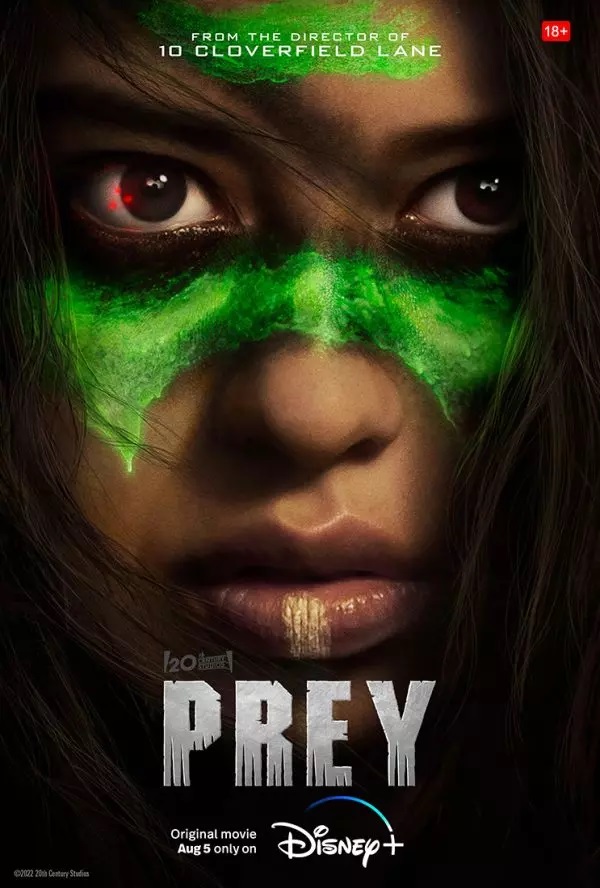
Northern great plains, September 1719. A young Comanche woman and mean French fur traders squares off against Hollywood's favourite crab-faced alien big game hunter. I've recently reviewed this colonial-era monster movie here.
Easily the best addition to the Predator franchise since the original.

(IMDB link here)

Movies I Haven't Seen Yet

Lost Colony: The Legend of Roanoke/Wraiths of Roanoke (2007)

Quoting IMDB: "In the 1580's English colonists arrive in what was to become North Carolina and find supernatural terror."

You know your movie is top notch quality when you can't even settle on a title *sarcasm*. I'm dying to see how bad this movie is (no pun intended). But based on the trailer, it doesn't bode well... Here's to hoping it's in the so-bad-it's-good category.

(IMDb link here)


Ginger Snaps Back: The Beginning (2004)

The Fitzgerald sisters arrive at a remote trading post run by the Hudson's Bay, besieged by werewolves.

This is the second movie on this list to feature werewolves. A sequel to the original 2000 Ginger Snaps, the movie inexplicably has the same main characters but in a colonial setting. Can't wait to get my claws on this one and see how bad/good it is.

(IMDb link here)


Eyes of fire (1983)


Quoting IMDb once more: "A preacher is accused of adultery, and he and his followers are chased out of town. They become stranded in an isolated forest, which is haunted by the spirits of long dead Native Americans."

Can't say I've ever heard of this movie. But watching the trailer, it looks hilariously bad. And I would be remiss if I didn't point out that this movie seems to inject steroids into the Indian burial ground trope common in the 1980s.

UPDATE: I watched it and wrote a review! Read it here.

Bonus

Just like after a hefty meal, perhaps you need a little something sweet after all these movies. I present to you 1985's Garfield's Halloween Adventure, where Garfield faces off against ghost pirates. Folks, my love for Halloween movies would not exist without this gem from my childhood. To this day, I'm convinced I don't simply have a nostalgic sweet spot for this special but that's it's honestly the next best cartoon Halloween special after It's the Great Pumpkin, Charlie Brown! The music is great, the jokes actually hit the mark, and dare I say, those pirates actually are creepier than many horror movies today, thanks in large part to C. Lindsay Workman's vocal performance as the Old Man. Truth be told, the only movie this short reminds me of is John Carpenter's The Fog, both sharing a maritime ghost story vibe. On that note, Happy Halloween to you all!


23 September 2019

En quête d’authenticité: costumes d’époque et Autochtones


Les représentations authentiques d'Autochtones
dans l'iconographie d'époque sont rares mais
souvent spectaculaires. Source: National Archives
Ma très chère amie Marie-Hélaine Fallu vient de publier une réflexion au sujet des costumes autochtones dans le film Le Dernier des Mohicans de Michael Mann (1992). Ce billet m’inspire à mon tour de partager ici une courte pensée au sujet du double dilemme pour les spécialistes de la Nouvelle-France. D’une part, les cinéastes nous consultent rarement au sujet des habits autochtones avant de tourner un film d’époque. De l’autre, lorsqu’ils le font, on peine à leur fournir du bon matériel visuel.

L'homme sauvage
"classique"
La réalité est que les bonnes représentations d’époques d’Autochtones en Nouvelle-France sont rares. Lorsqu’on les retrouve dans les sources imprimées, il s’agit le plus souvent de représentations fantastiques suivant les clichés et les modes artistiques du 17e et 18e siècle. Après tout, le tableau de la mort de Wolfe par Benjamin West était célèbre justement parce que (malgré ses quelques inexactitudes) il s’agissait du premier artiste britannique à chercher à représenter une scène historique de manière réaliste, plutôt que par le prisme de l’antiquité classique (comme la mort de Montcalm, représenté à la même époque avec des motifs grecs et romains). Les Autochtones, donc, étaient pendant longtemps représentés le plus souvent sous la figure de l’homme « sauvage » de la tradition classique. Il faut vraiment creuser pour trouver des images authentiques. Et même lorsqu’on en trouve, elles soulèvent souvent plus de questions que de réponses: s’agit-il dans ce cas d’un costume typique? Cérémonial? Pour la guerre? Le quotidien? À quelle nation appartient le figuré?

Une reconstitution
archéologique.
Source: Brown, 1971.
Bien entendu, il existe aussi de bons témoignages publiés d’observateurs européens qui décrivent en détail la manière de s’habiller des Autochtones (songeons à Pouchot). Des études historiques existent également, tout comme d’excellents rapports archéologiques qui nous en apprennent plus. Mais ce que je veux soulever ici est la rareté des ressources publiées, c'est-à-dire de bons imagiers, qu’un historien peut référer à un cinéaste sans avoir recours à une recherche approfondie.

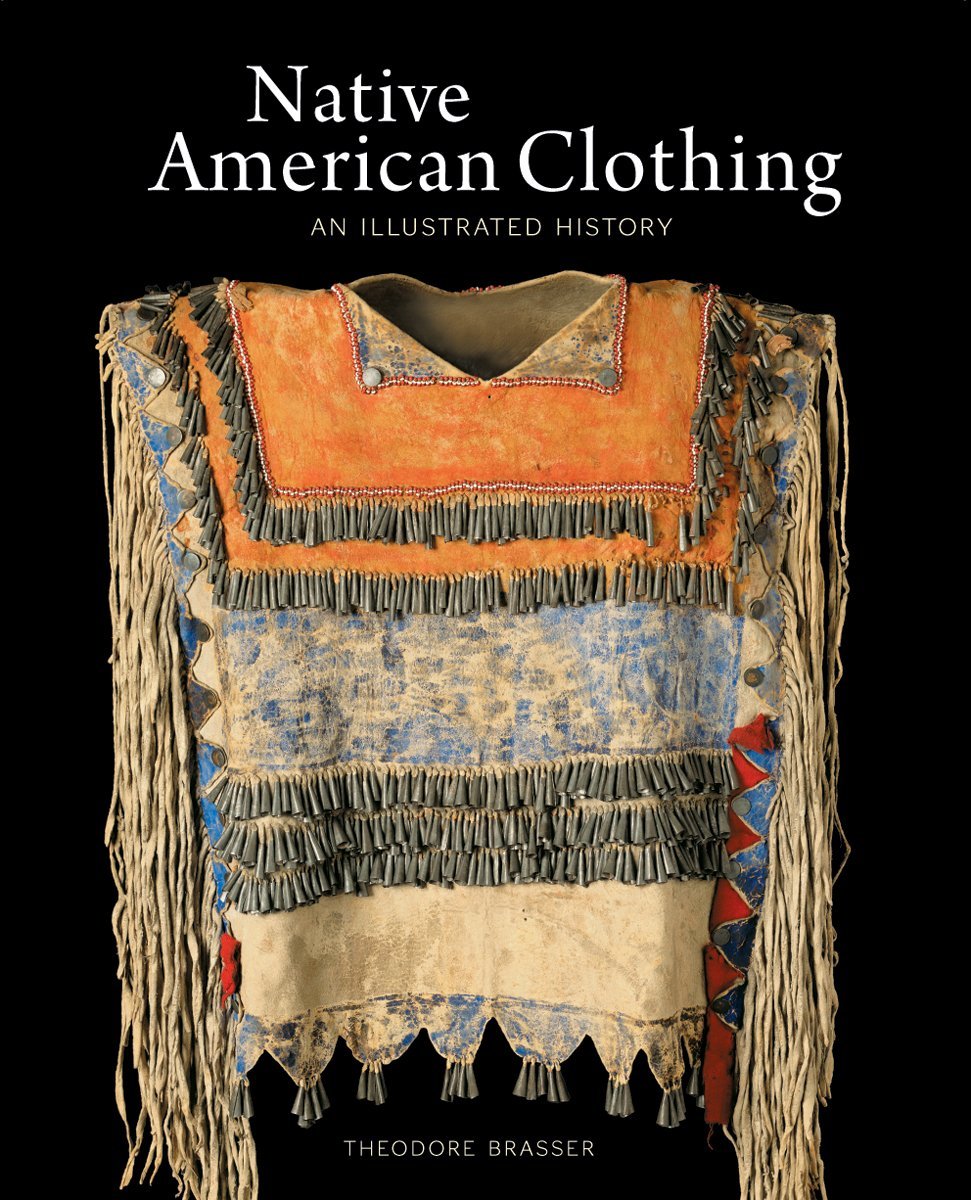
La première fois que j’ai offert à un cinéaste de l’aider avec sa recherche au sujet des habits autochtones en Nouvelle-France, j’ai consulté de nombreux collègues et nous sommes vite tombés d’accord qu’il n’y a que deux bonnes synthèses à notre connaissance (cliquez sur les images pour commander):


Néanmoins, ces deux livres ne font que gratter la surface de la période du Régime français qui s'étire sur plus de deux siècles. (Et en passant, si vous en connaissez d'autres, laissez-moi savoir). Bref, il n’y en aura pas de facile pour tout historien qui se fait aborder pour son aide en matière de costumes autochtones d’époque. Il doit s’attendre à creuser dans les sources et l’iconographie pour aider son client.

Tristement, même si un cinéaste veut être aussi fidèle à l’histoire et le plus authentique possible avec les costumes, il arrive qu'il n'a pas le budget à investir pour embaucher des historiens et doit souvent se contenter de louer des costumes préfabriqués. Dans ces cas-ci, ces restrictions imposées sont pardonnables. Mais dans le cas des grosses productions hollywoodiennes (comme celle en train de tourner à Québec en ce moment que je ne nommerai pas…), ne pas tenir compte des avis d’historiens est impardonnable. Dans le cas du Dernier des Mohicans, Michael Mann a tout de même cherché à rendre son film le plus authentique possible avec les informations à sa disposition au début des années 1990. Même si le film a sa part de petits détails mal interprétés, rien n’empêche que presque 30 ans après sa création, il se tient tout de même bien comme exemple de film dont le soucis d'authenticité est à imiter et à surpasser aujourd’hui.